Chat GPT and Me

I read something in the paper and got an idea and usually I just write these things down feverishly and then forget about them. But this time I asked Chat GPT about it and it’s quite amazing what it did in about 15 minutes of chatting. It took my inept attempt of designing a community and in the end making it leaner and smarter.

For whatever reason, I must speak to it like a person. I can’t do it otherwise.

Hi Chat! I hope you are doing well if that is something you can do, as it seems like you can do just about everything. So, check this out. 3,143 people work in Decorah, Iowa, which is a nice little college town. 1,064 people live there. Everyone else commutes. There is not enough housing. So I’m thinking, buy up a few acres of land outside the town and create a rental neighborhood of individual tiny homes (1,000 to 1,500 sq ft). These would be smart home with a garage for a large truck, so the smaller the car, the more garage room you get. Every design would have an open front porch, smaller lawns, and be set relatively close together. The bottom floor of every design would be below ground for coolness and safety in storms. The construction would otherwise be wood. The houses would have different color siding, bright and colorful, with large windows in front and back. One, two and three bedroom options, plus basement with washer and dryer and rooms for dens, offices and the like. We call it “Smultown” with an umlaut over the U, right? A play on small town, tiny houses, and my Swedish heritage. Did you know I’m 97% Swedish? Two DNA tests proved it. But with Smultown and like Haagen Daas we’re just making it up. A common building with the offices, gym, pool and the like. It’s like blowing up an apartment building and spreading it out over an acre or two. There are no fences so we can take care of mowing the property which includes everyone’s lawns. (We would not mow over anyone’s garden.) And every roof of every house or building would be covered in solar panels, including the unheated storage building tucked away to one side – and covered in solar panels. Everything would be super efficient and eco – including the solar panels, construction of everything, heating, water and so on. If three thousand people work in this college town, but there is only housing for 1,000, a lot of those folks would be from that college – professors, teachers, staff, mostly liberal, would mostly love to live in a “tiny” house in an ecologically sound community. It may also inspire other similar communities. Electric car chargers in every garage? What do you think? I want your honest answer. 

ChatGPT said:

I think “Smultown” (with the umlaut for flair) is a compelling idea, and the concept checks a lot of boxes for modern housing needs—especially in a small college town with an obvious housing shortage. Here’s my honest take:


Strengths of Your Idea

1. Clear Market Demand

  • The numbers you shared—3,143 working there vs. 1,064 living there—point to a real supply-demand imbalance.
  • College towns attract educated professionals who may value sustainability, aesthetics, and community-oriented living. That’s a good match for your eco-friendly, design-conscious approach.

2. Lifestyle Appeal

  • The open porches, colorful exteriors, and close-knit layout foster a sense of neighborliness.
  • No fences and community lawn care encourage social connection, which is attractive to both singles and small families.
  • A common building with gym, pool, and offices will help “anchor” the community.

3. Sustainability & Efficiency

  • Solar panels on every roof and shared eco-friendly infrastructure would be a big selling point—especially in a progressive college town.
  • Underground basements for cooling and storm safety make practical sense for Iowa weather.

Challenges to Anticipate

1. Land & Zoning

  • You’ll need to check county zoning laws for density, minimum lot sizes, and whether a community of closely set tiny homes is permitted on agricultural or residential-zoned land.
  • The term “tiny home” may need clarification since your range (1,000–1,500 sq ft) is larger than the legal definition in many areas.

2. Infrastructure Costs

  • Running utilities (water, sewer, power, fiber internet) to each home, plus installing solar for every unit, can be capital-intensive.
  • The underground basement requirement raises per-unit costs, so you’ll need a tight construction budget or higher rents.

3. Financing & ROI

  • Upfront cost will be high—land purchase, infrastructure, home construction, and community amenities.
  • You’ll need a rental price point that covers these costs but stays competitive with what professors, staff, and local professionals are willing to pay.

Opportunities to Strengthen It

  • Electric car charging in every garage: Yes—this future-proofs the neighborhood and appeals to eco-conscious renters.
  • Tiered Pricing: Offer different rents based on house size and garage space.
  • Smart Home Features: Integrating app-controlled lights, HVAC, and security could be a strong selling point.
  • Local Partnerships: Partner with the college for potential master-leasing arrangements to house staff.

Overall

It’s a smart, market-driven idea with a lot of built-in appeal. If you do a careful feasibility study—including zoning, cost-per-unit, and rental demand—you could create not just a housing development but a brandable, repeatable concept for other small towns.

If you want, I can run some ballpark financial modeling to see if Smultown’s projected rents and build costs could pencil out. That would tell us if it’s just a fun idea or a viable investment.

Do you want me to run those numbers?

You said:

That’s brilliant, man. Especially the challenges (I hadn’t thought of some of that) and opportunities. Please run those numbers.

ChatGPT said:

Thought for 1m 32s

Smultown – Pro Forma Summary

ScenarioUnitsAvg finished SF / unitProject Cost ($M)
Clubhouse + Pool36151118.01
Clubhouse (no pool)36151117.07

Smultown – Assumptions

AssumptionValue
Acres6.0
Land $/acre85000.0
Units36.0
Mix 1BR count15.0
Mix 2BR count14.0
Mix 3BR count7.0

Thought for 4 secondsThought for 8sThought for 5sThought for 13sThought for 22s

Heck yes—let’s put some math behind Smültown 😊 I built a quick, conservative pro forma using current Decorah rents and Iowa build costs. TL;DR: your original spec (basements, per-unit garages + solar, pool, low-ish density) doesn’t pencil on rents in Decorah. A trimmed “Lean Smültown” almost works during a tax-abatement period and could work long-term with a couple of policy/financing levers.

I dropped two live tables in your workspace so you can poke around the numbers:

  • Smültown – Pro Forma Summary (two versions of your concept)
  • Smültown – Assumptions

And here are CSVs you can download:

What I modeled (high level)

  • Current market rents (Decorah): Zillow shows ~$1,100–$1,280 median/average; Apartments.com lists ~$941 1BR & ~$879 2BR (data’s noisy, so I used a blended $1.1k/$1.35k/$1.6k for 1/2/3BR and added a premium for new). ZillowApartments.com
  • Land near Decorah: recent listings imply ~$80k–$90k per acre (e.g., 4.12 ac at $359.9k). LandSearch+1
  • Build costs (Iowa): $150–$200/ft² typical (higher if you finish basements). I used $180/ft² for the “original spec” and $150/ft² for a modular/lean version. Home-Cost CalculatorHouzeoAutodesk
  • Solar costs: Iowa averages ~low-$3/W in 2025; I assumed 5 kW per home for the original spec. Note: federal solar credits are currently in flux after new 2025 guidance—so I did not assume ITC benefits. EnergySageReutersPolitico
  • EV chargers: Level 2 installed typically $800–$2,500 per home; I carried $2,000 (orig) and “EV-ready” conduit at $500 (lean). J.D. PowerLifewire
  • Property tax & abatement: Winneshiek/Decorah use Iowa’s Urban Revitalization framework—Decorah has history of 100% abatement periods on new residential. I ran scenarios with a 5-year 100% abatement on improvements (common locally) and withoutdecorahleader.comIowa General Assemblydecorahia.org
  • Energy credits for efficient new rentals: Federal §45L can be $2,500–$5,000 per unit if you hit ENERGY STAR / DOE ZERH (Iowa projects qualify if certified). I only used a conservative $2,500/unit to show impact. ICS Tax, LLCBuilding Innovation Hub

Results (the short version)

Your original spec on ~6 acres, 36 units (1–3BR, finished basements, big garages, pool + clubhouse, per-home solar & L2 chargers)

  • All-in cost: ≈ $18.0M (~$500k/unit)
  • Debt (65% @ 7%, 30-yr): ≈ $11.7MRequired avg rent to hit 1.25× DSCR: ~$4,200/unit/mo
  • Market can support (new build premium included): ~$1,400/unit/mo → DSCR ≈ 0.16 (nope).
  • Dropping the pool saves ~$950k, but you’d still need ~$4,000/unit/mo to pencil.
    (See the first two rows in the “Pro Forma Summary” table.)

Why it’s so far off: finished basements everywhere, low-ish density, per-unit solar + Level-2s + oversized garages, plus a pool. Meanwhile, Decorah’s rents are modest for Iowa college towns. ZillowApartments.com


“Lean Smültown” (what it takes to get close)

Assumptions: ~80 units on the same 6 acres via PUD/cluster (tiny-home vibe but truly compact), no basements (use shared storm shelters), carports instead of full garages, EV-ready conduit (chargers optional), community solar on common roofs, small clubhouse (no pool), modular/panelized build.
Result snapshot:

  • Cost: ≈ $15.2M net of a modest §45L ($2.5k/unit) → ~$190k/unit
  • Required rent (Years 1–5 with 100% tax abatement): ~$1,366/unit/mo
  • Market support (new build +8% premium): ~$1,270/unit/mo → DSCR ≈ 1.17× (almost there).
  • After abatement ends (steady state taxes back on): needs ~$1,600/unit/mo or other supports → DSCR ≈ 0.92× at market.
    (See the “Lean scenario” rows in the table I shared.)

Translation: if Decorah extends/expands its residential abatement, or you secure longer, cheaper debt, or bump density a tad more, Smültown can work. Without some combo of those, it’s tight.


Practical levers that move the needle (my honest take)

  1. Zoning & utilities (biggest swing):
    Inside city (or annexed) with cluster/PUD is key. Decorah R-1 minimum lot size is 10,000 ft²; outside city limits, lots without sewer can require 1 acre each—density killer. So, this really wants city utilities + PUD to cluster homes tighter. Municode Librarywinneshiekcounty.iowa.gov
  2. Ditch basements; add shared storm shelters: keeps costs down ~15–25% vs. finishing a full lower level in each home. (Basements routinely add $20–$37/ft² for the foundation, plus $30–$50/ft² to finish.) Home AdvisorHomeGuide
  3. Right-size the amenity package: a friendly clubhouse + co-working gym can be <$1M; a pool can run $0.7M–$1.5M+ for even a small community build in the Midwest. recmanagement.comSports Facilities Companies
  4. Solar strategy: shift to community arrays (on roofs of the clubhouse/storage) that offset common-area loads and future-proof EV charging. Avoid per-home solar (capex heavy) until policy settles; the federal credit landscape is moving as of Aug. 2025. ReutersPolitico
  5. EVs: make every stall EV-ready (conduit + 240V capacity) and install Level-2s where pre-leased—saves ~$1k–$2k per unit up front and scales with adoption. J.D. Power
  6. Tap incentives on the table:
    • Residential tax abatement (Decorah’s used 100% for several years on new res)—structure a multi-phase plan with a full 5–10-year schedule for multi-res cluster. decorahleader.com
    • §45L credit ($2.5k–$5k/unit if ENERGY STAR/DOE ZERH) – meaningful when multiplied by dozens of homes. ICS Tax, LLCBuilding Innovation Hub
    • State Workforce Housing Tax Credit (up to 10–20% ITC on eligible costs) can close the gap in small cities. Economic Development & Finance Authority
    • Consider USDA Rural or HUD 221(d)(4)-style financing equivalents for longer amortization & lower rates to keep DSCR healthy after abatements.

Quick answers to your earlier points

  • Chargers in every garage? Technically easy; budget $800–$2,500 per home. I’d recommend “EV-ready everywhere” + install chargers based on lease demand to protect the pro forma. J.D. Power
  • Bright color siding, porches, small lawns, close-set homes? 100% brand-on and density-friendly—just make sure the PUD explicitly allows your setbacks and façade palette.
  • Solar on “every roof”? Feels great, but it’s capital-intensive. Start with community solar + wired roofs for later phases.

If you want, I can spin a few more variations (e.g., 60/72/96 units; with/without garages; modest pool vs. splash pad) and show how each change shifts “required rent” and DSCR. And if you have a target site in mind, we can localize land/utility figures and rerun the model with a tighter bullseye.

Sources for key inputs: rents (Zillow & Apartments.com), land pricing (active Decorah listing + averages), Iowa build & basement costs, solar & EV charger costs, Decorah/Winneshiek zoning & abatement, and §45L details. ZillowApartments.comLandSearch+1Home-Cost CalculatorHouzeoHome AdvisorHomeGuideEnergySageJ.D. PowerMunicode Librarywinneshiekcounty.iowa.govdecorahleader.comIowa General AssemblyICS Tax, LLCBuilding Innovation Hub

Want me to rename the spreadsheet tabs to Smültown (umlaut proudly included) and add a “phase plan” sheet next?

Sources

You said:

Wow! That blows my mind. I love the lean idea, not only because of the cost, but it feels more eco. I did not know that basements were so expensive. Maybe that’s why they don’t have them down south? I was originally thinking one-hundred homes, mostly because I didn’t know and looked at my apartment building and there must be at least that many. I would also bet that we could charge a fair amount more than any average. But maybe not. I’m going to have to download all of this and read it in more depth. You’ll remember when I come back? 

ChatGPT said:

Yep—basements are a big cost driver, both in excavation/foundation work and in finishing them out. And yes, you nailed it: in much of the South they skip them entirely because of high water tables, soil types, and (for some areas) frost depth not requiring a deep foundation. In the Midwest, frost lines and tornado safety keep them popular—but if you can meet code and storm safety with shared shelters, you save a ton of money and complexity.

I’ll remember this whole Smültown discussion when you come back. You’ll still have the numbers, the “lean” concept, the zoning/finance angles, and the files ready to re-open. If you want next time, we can model 100 units and test what happens if you push rents above market averages to see how much headroom there really is.

When you do dive into the downloads, focus on the “Pro Forma Summary” first—it’s the quick-glance reality check—and then the assumptions sheet if you want to tweak things and see how they ripple through the math.

Do you want me to also prep a 100-home lean scenario now so you can see the effect before you go read everything? That way you’ll have the full range when you come back.

You said:

Yes and maybe raise the rents 25% and then 50%? You do what you think is best. 

ChatGPT said:

Here’s how a 100-home “Lean Smültown” pencils out with different rent levels (all numbers include the baseline new-build premium of +8% baked in, then your extra % increase):

UnitsAvg SF/unitProject Cost ($M)Cost/UnitAnnual Debt ServiceRequired Avg Rent/moMarket Avg Rent/moDSCR @ Market Rents
10081018.65$186,460$999,504$1,593$1,270 (+0% over base)0.93×
10081018.65$186,460$999,504$1,593$1,564 (+25% over base)1.26×
10081018.65$186,460$999,504$1,593$1,857 (+50% over base)1.59×

What it means:

  • At current market +8% new build premium, 100 homes would almost break even on DSCR (0.93×).
  • At +25% above base, you clear the 1.25× DSCR target—lenders would like that.
  • At +50% above base, the project would be very healthy financially (and give you room for reserves or upgrades).

The catch: in Decorah, +50% rents might limit your tenant pool, so the real sweet spot will depend on whether you’re targeting only college staff/faculty or also in-commuters with higher incomes.

Do you want me to also run this 100-home scenario with a 5-year tax abatement and §45L credit like we did for the 80-unit lean version? That would drop the required rent in the early years. 

You said:

No. I have enough for now. This is so amazing. I’m still overwhelmed by you. Thank you and until next time…

ChatGPT said:

You’re welcome, and I’m really glad you’re excited about this!
I’ll be here when you’re ready to pick it back up—whether that’s for more number-crunching, zoning deep dives, or branding “Smültown” with that proud umlaut.

Until next time, enjoy reading through everything.

I’ve never seen an asshole

I’ve never seen an asshole die of cancer. Everyone I know has been among the kindest people I knew. I wonder what this is like to experience – the death of someone who has been cruel and angry and awful, and succumbing to cancer. Do they change? I wanna hear about a morning-after Scrooge epiphany. A great transformation of spirit! Or do they mostly just go out in a blaze of hate and unhappiness? Just one more way the universe conspired against them.

News Letter 020925

Just to note

I found this in the paper today. A coach’s description of a new player in perfect sportsese. “He has the ability to make plays,” __ said. “He’s got good hands and can shoot the puck.”
Nice. 

February 28, 2025

Good people gotta get together. One great thing we can do that I’ve heard about is getting off social media and any media and spending no money anywhere on February 28, 2025. Especially online or large retailers. Money is one of the psychopaths’ two languages; this would send a very strong message that we are the ones with the real… Power is the other language they understand. Neanderthals.  
Let’s take it away for just one day.
To start.

From Harper’s Index

Estimated amount of energy, in kilowatt-hours, that was used to discover a new prime number last year: 3,100,000

Estimated number of U.S. households this amount of energy could power for a year: 287,000.

The world is full of these things that just slip by.

I love this

From: “The Painted Protest: How politics destroyed contemporary art” by Dean Kissick in Harper’s December 2024. I love Harper’s. Can you tell?

SCIENCE!!

“In his 2022 book The Mind of a Bee, behavioral ecologist Lars Chittka chronicles his decades of work with honey bees, showing that bees can use sign language, recognize individual human faces, and remember and convey locations of far-flung flowers. They have good moods and bad, and they can be traumatized by near-death experiences such as being grabbed be an animatronic spider hidden in a flower. (Who wouldn’t be?)”

From “Minds Everywhere” by Rowan Jacobsen, in Scientific American February 2024; Illustrations by Natalya Balnova 

(Do I need to cite an artist when I’m just pulling a quote?)


Kendrick Lamar and the Super Bowl Halftime Show

The Super Bowl Halftime Show is an extravaganza of outrageousness. But it can be really cool. I just watched Kendrick Lamar – I have one of his albums – “To Pimp a Butterfly” – and I dig it and see his genius throughout his career and know how talented he is. But the extravaganza of outrageousness calls for a can-be-somewhat outrageous artist, an artist that can match that huge stage, in the middle of a boring (or exciting) football game, like Prince. Prince owned that huge stage.  And I think that is partly because the tempo of his music changed.  He could start slow and build up for the audience and then blow the doors off the place. Which he did. Rap songs mostly stay with one tempo which makes it harder for the artist to do what a Prince or Bruno Mars or Madonna can do. That is my theory of Kendrick Lamar and the Super Bowl Halftime Show

Luke Digs Deep to Discover How Tempo Affects Mostly Wealthy Listeners Clutching 24 Ounce 75 Dollar Beers in a Dark Stadium During the Halftime Break of an Athletic Contest

Stop the money. Save the nation.

I do this every once in a while where I write something after some immersion in the bad news of the day. Note that the current bad news is worse than it’s ever been in my lifetime. But I start pontificating on the evil, greed, hate and blah, blah, blah. This time I’m quite a bit more freaked out but when I got done and reread it, I was struck by how silly it all is. Bestowing upon the world my opinions on whatever. Here’s what we need to do! Whatever. But it’s cathartic and so ultimately it’s worth it, right? And I kind of like this one. Here goes:

Everybody right now open an account on Bluesky. Good Americans can talk there. 

Completely shut down all of your other social media accounts –  X, Facebook, Instagram, YouTube, TikTok, etc. All of them. We’ll do this fast and we’ll do this right and you can get your accounts back. Grab your data, or start fresh. Do it now. 

Do not buy anything from any of those companies – purchase nothing on Amazon, close those accounts also, do not buy a Tesla, if you have one, enjoy it and drive it into the ground. Do not use Elon Musk’s satellite connections, nor any of his other companies, and those of you who do the science as astronomers and engineers and the like working for him, you’re smart! Get the fuck out of there! Anybody working for any of those companies, walk now.

Disrupt the activity of everything related to those same businesses. This of course includes Trump companies.  Whatever you can do. Good hackers, this especially means you. Blow our minds.

Yes, this will create hardship, but if we do this fast and we do this right, we’ll get through it easily and the old-fashioned way, taking care of one another, looking after our neighbors. We’re the good Americans, remember? We can take a little hardship. In fact, we can take a lot of hardship to save the nation – and ourselves, our families, our loved ones, our friends and coworkers and neighbors.

If we do this fast and we do this right, we can avoid violence of any kind. That being said, everyone be prepared to the best of your abilities. 

The only two things they understand are money and power, and they will stop at nothing to use their power to bring us to our knees and take all the money for themselves. They are doing it right now. Right in front of our eyes. We must immediately stop the flow of any money into their businesses.

Please pass this on to everyone you know. 

It’s like camping in comfort of your own bed

I don’t sleep well. I did when I drank, but that was more a passing out than going to sleep. And that went on for 40+ years. That freaks me out. I don’t even feel 40, mostly. But I don’t sleep well, and I’ve tried everything except any sort of sleeping medication – real ones, good ones. The ones that work. And that’s why I didn’t take em, because they work. I’ve taken many a drug in my time, but for whatever reason, I didn’t want to go there. Alcohol knocks you out, as I noted above, but you get those 7 hours of drinking leading up to it. Popping a pill and dropping off like boom is weird. It’s like the fancy people who always have proper meals and you stand at the sink wolfing down leftovers out of the to go containers. Maybe.

So, New Years Eve night before we were to go on a strict budget on January 1 I was on social media and got an ad for sheets that were able to be grounded and so ground you as you slept. Seriously. Here’s the ad. Okay, I can’t put the video up for some reason. Anyone know how to insert an Instagram ad into a blog? But found this one with the same guy. https://youtube.com/shorts/tdD0xP4040s?si=hT2Q90eQpP-4Z-bg

I thought, what the fuck? Even if it’s a bunch of hooey I get sheets, and I need sheets. But I do have to say that ad kicked ass. The guy talking is perfect, handsome, sciency but normal, and what he says and claims about this grounding business blew me away. While, of course, raising the beware internet scams flag. But I bought them and about two weeks ago they arrived. Well, they didn’t. What arrived was 9×12 padded envelope. Inside was a piece of sheet, I guess, about two feet wide and 8 feel long. And a cord that snaps onto the sheet with just the little round ground plug on the other end that I plugged into the nearest outlet. That’s perfect me, by the way. I didn’t bother to read the thing. I just went to the first item on their website, I suppose, and somewhere saw “sheet” and clicked buy. It was $99. Which was expensive even for a full set of sheets for a guy like me. I got ripped off, I figured and will forget to even try to return it. That’s the MO. I’ve got issues. 

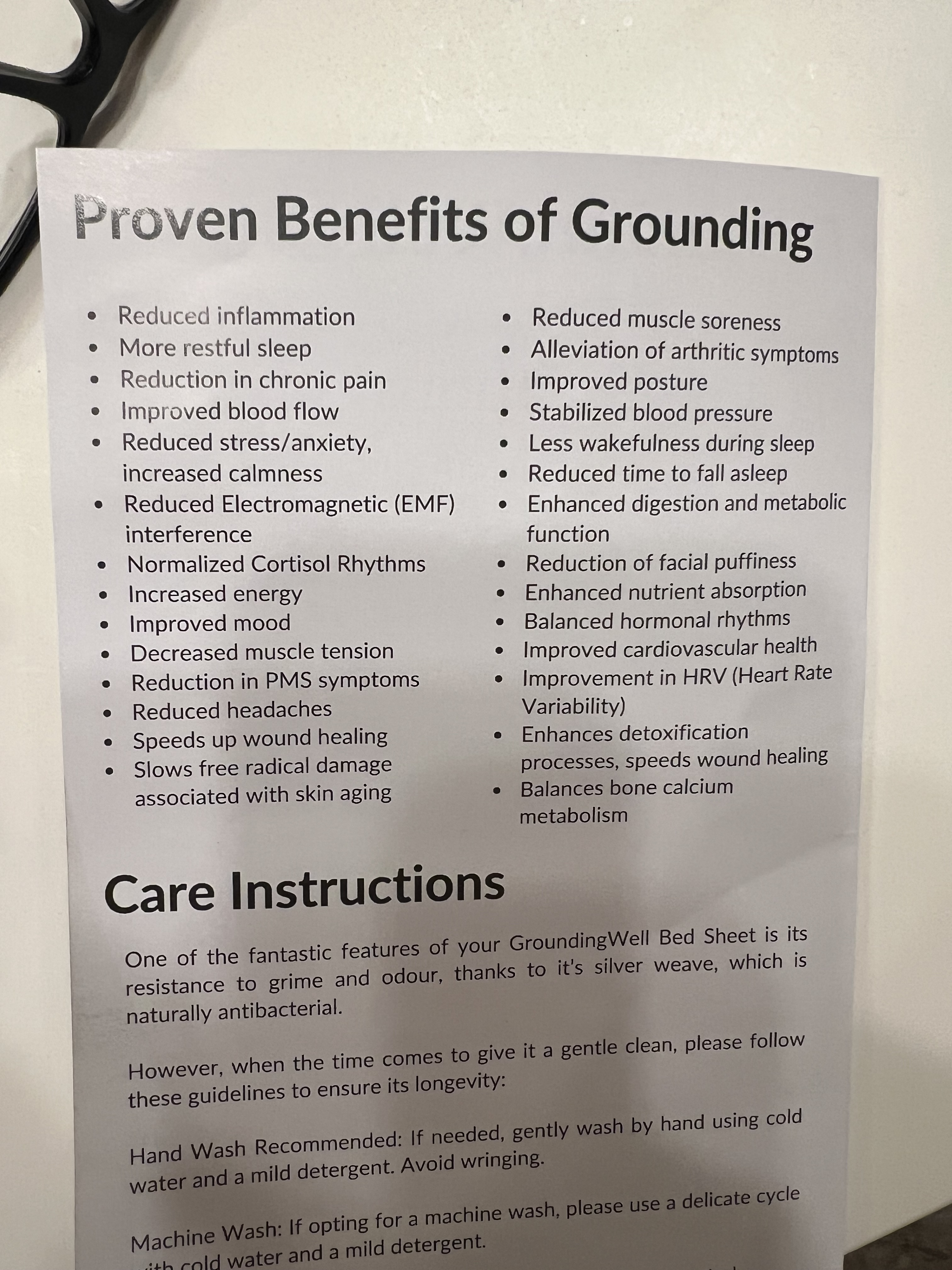
This came also in the envelope. 

Feast your eyes on what this thing can do. These are some serious claims, although “Enhances detoxification processes” sounds a bit bullshitty. 

So, I plug in my slip and slide lookin grounded sheet, strip naked to get the whole effect and lie down on it. I immediately experience what feels like the energy in my body falling down toward the fabric. It was weird but it also felt really good like that meditation of feeling the weight of your body being pulled toward the floor. My jaw was tingling. 

All right, I figured it was me being all excited about it, some psychosomatic or placebo effect. So I got up thinking that it was for sleeping on anyway and walked away. Later in the day, I tried it again, and I got the same feelings. Still, though, placebo and for sleep. 

I slept that night. Much, much harder than I had for as long as I can remember. It was a feeling I remembered now but had forgotten. I dreamed again. I hadn’t dreamed in a very long time. I usually wake up a couple-three times at night and I only woke up once. Could this thing seriously be for real, was grounding in this way somehow able to grab hold of my circadian rhythms and get them dancing in unison? Do we have more than one circadian rhythm?

PLEASE NOTE I AM NOT SUGGESTING IN ANY WAY THAT THIS MAKES ANY SENSE TO ME AND I AM NOT SHILLING FOR THIS COMPANY. THERE ARE A MILLION OF THEM OUT THERE I GUESS GROUNDING PEOPLE THROUGHOUT THE LAND. THIS IS NOT A SPONSORED BLOG, NOR HAVE I HAD ANY CONTACT WITH ANYONE RELATED TO THE COMPANY, ALTHOUGH I’D LIKE TO MEET THE GUY IN THE VIDEO. I THINK HE’D BE A GOOD CONVERSATIONALIST. 

It’s been a couple of weeks and it’s still working. I’m sleeping way better. And I can still feel the energy thing. But maybe it’s still psychosomatic or placebo. I don’t know. How can I know? But could something this simple have merit like this? Sitting right under our noses for all these many years. Just sleep on the ground, fool! I’ll bet cowboys slept well.

Remember Science?

When I was a young man, science was the one place all Americans could agree on, even if they didn’t understand the science itself. That is because they understood the scientific method that simply states that we don’t know something until we can prove something, a terrible paraphrase. So, in the case of climate change, it is understood that CO2 traps heat. That is proven and so everyone should get behind that, but what that would mean in our day to day lives, we weren’t sure about and so could be discussed without stepping on the scientific method. Turns out, by the way, they underestimated how serious it would be. But no one in those days was against science. It would be like being against curiosity or the desire to learn more or understand something better.

That has changed. Over the years, the Republican Party has embraced an anti-science agenda, which is beyond weird until you consider the source. Despite what any republican voter thinks, that party is in place for the ultra-wealthy and keeping them that way. They don’t care about the border or trans people or any of the other issues they throw at their voters to get them riled up. Republicans had the White House, senate and house during Trump’s first presidency and they did absolutely nothing about the border. These types of issues are golden for republicans for the very reason stated above, they need them to rile up the base and get them to vote based on these issues, while paying no attention to what really matters. And it works. I can’t tell you how many Minnesotan republicans I’ve seen interviewed who brought up the borders. Minnesota. Only Alaska is farther away from the southern border, I think. Oh, and Hawaii. They’re riled up as they eat fruit picked by immigrants, go to restaurants with kitchen staffs filled with immigrants, have repairs done on their homes by immigrants and so on. And just how many Minnesotans have had a bad experience with a trans person? None?

The new Trump White House just abruptly cancelled all scientific meetings without any rescheduling. This included gatherings and panels and the like. But why? Because if we followed the science, we’d have to invest in policies that will help the whole nation, and the entire world, in the case of climate change. We’d get behind renewable energies, which are scientifically proven to be better in our fight against climate change. The new issue is that those renewable energies are costing less and less and less due to science-based upgrades to the technology and the costs of manufacturing. So, you’d think that republicans, who famously hate paying for anything and particularly taxes, would embrace renewable energies. Nope.

But that gets to another point about republicans. Yes, they would save the nation money now, bring down he cost of energy for all of America, and help the nation and world slow climate change. However, those at the top of the republican pile, the men and women Trump brought on stage at the inauguration, don’t care about saving that kind of money. Whereas, we read constantly stories of homeowners who opted for solar and now not only don’t pay for their electricity but even get money back for it. That’s huge for the average American, republican or democrat, but chump change for those folks. It’s not even on their radar. But what is on their radar? The wealthy fossil fuel industry who would rather watch the world burn than lose their oversized piece of the American pie.

Elon Musk, who sat on stage with Trump and offered up a Nazi salute(?) and gave a quarter of a billion dollars to Trump for his reelection, among other things makes electric cars and solar panels. Does Elon Musk care about climate change? Ten years ago I would have said, yes, absolutely! But now, not at all. He saw profits, money and power, and he got them all in spades. He spent 250 million dollars on a man who hates electric cars and solar and wind and so on. But Musk knows that electric cars are our future, as are solar panels, so he plays both games.

I’m certain we need better science and civics education in high school – and throughout high school. Civics should not be a one-off class as it was for me. The science doesn’t need to go particularly deep, but create a good understanding with students about its importance, the scientific method, and how it is absolutely ignorant to somehow turn against it as Republicans have. As for civics, our voters are woefully ignorant of this and without an understanding of our governments, what they do and our role in making them work, we’re screwed.

multiple viscosities and hues 

I want to write a book about snot. It fascinates the shit out of me. It takes so many interesting forms, so many viscosities and hues.  Some snot can stick to a sink in perpetuity if no one takes a pressure washer to it. I imagine it would be a handy adhesive and maybe our forebears loogied to hold things together. It’s not all that far-fetched, but what do we know? 

When you think about it the earth is our only actual god that we can be sure of and the earth gives us everything and every opportunity to live and thrive as long as we’re nice to it

Like Holy Shit

It comes from the earth
natural processes like
the earth working
on the earth
or a still
cooking dead life
to a new drug
(num num)
petroleum

A junkie surrounded
detritus floating
an oily flotilla
ridiculous ludicrous
malleable colorful
in and out of focus
a pendulum
travesty/convenience
but there
always there everywhere
plastic/petroleum
petroleum/plastic
micro
plastics
everywhere
like holy shit

Macro Micro Plastics

This from Harper’s Findings June 2024:

“Microplastics were found in sixty-two of sixty-two human placentas from a biobank in Texas, in half the arterial plaques of Campanian carotid endarterectomy patients; in the gastrointestinal tracts of three bottlenose dolphins and a harbor porpoise in the Black Sea; in shrimp in South Africa’s Crocodile River; in two-thousand-year-old archaeological remains buried seven meters underground; and in the gonads of adult oysters in the Mangrove Coast of the estuarine Brazilian Amazon.”

Found their way seven meters underground. And we have no idea regarding the long-term effects of microplastics on humans. We just went with it many years ago and here we are. But are we seeing it already? I read a while ago that tests on mice showed them suffering from both physical and mental maladies, and got, well, dumber. You think?

Love it but leave it

I remember hearing something along the lines of, you can tell the soul of a society by the tallest buildings. They talked about how it was once the church spires and then the government domes, and now corporate skyscrapers. Where the money is, there too is what we care most about. Stadiums.

Whoever came up with: He who dies with the most toys wins, nailed it. We are consumers, if nothing else. Consider the McMansion and explosion of storage facilities. We continue to move away from churches, and no one seems to care about good governance nor is willing to happily pay their taxes for the services they provide. Instead, we focus on us (our accounts, our feeds, our playlists, our entertainment, our silos and echo chambers), and better yet, they focus on us.

Consumerism isn’t new; but in about 1995, it was like a teed-up golf ball and the Internet swung in like a 1-wood.

It’s all very obsessive and dizzying, chaotic and endless, and that’s good for the Google, Facebook, Amazon and the like. They control it, and uniquely control each of us – what we see, how often, and all through a Pavlovian rewards system that responds to our every click – a different experience for every man, woman and child who logs in and turns on. And now it’s about you – your likes, your way of thinking, your videos, your music, your beliefs, your followers, your clothes, your hobbies, your culture – and so, as Greg Jackson in “Sources of Life” writes, “we create a culture in line with what we have been told the culture is like.”

The constant reaffirmation of ourselves online makes it easy forget the rest, or ignore them, misunderstand them, demean them, hate them. We’re developing personal cultures that sometimes intersect or overlap with others but mostly not. I’ve got my earbuds and you’ve got yours.

But to be free and alive, healthy and not crazy, we have to curate our own minds – extricate ourselves from the fast flowing feeds. Choose on our own what we want to put in our minds, and really think about it, as whatever we choose becomes us, too. Neuroplasticity, the ability and in fact, simply fact about our minds is that they are changed and altered, even physically, by what we see, hear, feel, taste, experience. The more we see the same product in our feed, the more we’ll remember it and maybe buy it. If you repeat anything over and over and over, you will eventually believe it. Just ask the religions.

Jackson writes, “Defending art or culture for its own sake may seem trivial, even gratuitous, amid our present crises, but our crises have flowered in the soil of its trivialization. The vacant secular despair that sends us searching for a religious politics – that underwrites the allure of racism, nationalism, conspiracy theories such as QAnon, the violent fraternal gangs; that makes us long for the escapism of entertainment, narcotics, video games and for the endless stimulation of the internet and social media – is precisely what culture of this category is meant to address.”

Support the arts. Curate your own mind.