“We may think we vote in line with our economic interests and social values, but our politics may be driven largely by our biological makeup. University of Nebraska researchers measured how aroused the nervous systems of highly conservative and liberal voters became while they viewed positive images, such as pictures of babies or cute animals, and negative scenes featuring car wrecks or fearsome insects. The conservatives showed greater interest in negative images, while the liberals responded more strongly to positive ones. When researchers showed both groups collages that intermingled positive and negative images while tracking their eye movements, they found that conservatives focused on the more alarming material. Even on a physiological level, conservatives appear to spend more energy ‘monitoring things that make them feel uncomfortable,’ psychologist Mike Dodd tells LiveScience.com. That may make them more receptive to campaigns that stress their fears, while liberals are more drawn to hopeful plans for the future. ‘It’s amazing the extent to which they perceive the world differently,’ said political scientist John Hibbing, who helped design the study.”
The top-performing stock of the past 25 years isn’t Apple or Microsoft. It’s Minnesota-based hardware supplier Fastenal, which is up 38,565 percent since the market crash of 1987. Told of the distinction, 72-year-old founder Bob Kierlin said, “Oh, wow. Gee. Well, thanks. That’s great news.”
That would be the title of my new book, inspired by the notion or idea or phenomenon that everyone or every entity wants to do everything or many more things than they should, by gum! I’m inspired again to write the book because of how many opportunities there are for my kids to trick or treat. What happened to trick or treating on Halloween night in your neighborhood? Now the malls do it, the schools do it, shopping districts do it, my kid’s pre-school does “trunk or treat” where the parents park in the parking lot and decorate the trunk or back of suv or whatever and the kids walk around and get treats. My bank has a Santa. Target has groceries. Gas pumps have tv. STOP!! That’s all for now.
The Grover BORGquist: resistance, apparently, is futile
The Grover BORGquist descended upon the Publicant’s and entered the party through the bottom, taking the easy path past the least of them; then veered right again and captured most of the rest of them. They signed themselves over, pledging themselves to assimilation with the BORGquist, They gave in and gave up on independent thought and action. (‘Rolled over and took it up the sick bay,’ might say.)
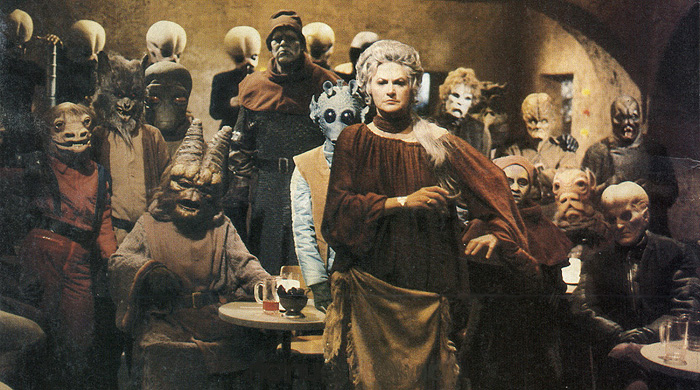
Cantinacrats
Meanwhile at the Democantina, all hell was breaking loose again. The party was on, everyone was represented – locals, freaks, foreigners – and everybody was demanding to be heard, like barkers at some whacked out baazar and there was no order because there were too many people and too many opinions; factions; ‘factionistas’ one man opined. Cantinacrats. But the music was good.
The final bill for the wars in Afghanistan and Iraq, a new Brown University study says, will come to between $3,700,000,000,000 and $4,400,000,000,000 ($3.7 Trillion and $4.4 Trillion), including nation-building efforts; the cost of providing medical care, services and long-term benefits to veterans; and interest on what the U.S. borrowed to fund the wars.
Interesting article here. We’re finding things very similar with our clients and their Facebook presence. You can generally get people to “like” your company – especially if you offer something in return, but even if you stay truly active with your page, offering that “good content” that we all assume people are clamoring for, people seem to lose interest fast. I think there are a couple of reasons for that:
1. As much as we all in the branding business like to believe it, people really don’t give a crap about most brands. Certainly there are some people who are serious brand advocates for a very small number of brands, but the other 99.99 percent of your customers just want what they want from you and then want you out of their face fast. (Unless you’re Apple, apparently.)
2. I agree that by far the largest majority of people don’t go to Facebook to do business or engage with businesses or brands. They go there to chat and gossip and just hang out. Having a company/brand insert its face into that time is really kind of annoying to most people.
3. People sense a sort of grim determination among companies to get onto Facebook and get into their face. It’s like they’re screaming “Look! Look how relevant we are! Cutting edge and all that!” And it all seems rather forced.
This could certainly change over time, but with all the brand messaging flying at each of us all day long, I really don’t see people welcoming it much more on their “social networking” site.
I’m surprised I’m writing about this, because this is my day job, but Comcast gave us the absolute worst brand introduction/education effort E.V.E.R. with XFINITY, whatever the hell that means. I’ve seen tv, billboards and print ads and I still have no idea how or why they are related to Comcast. Is Comcast going away? Is XFINITY a different service? Same great service, brand new ALLCAPSNAME? I just got another mailing from Comcast that said “Get even more from your XFINITY service.” I was thinking, “Do I have XFINITY service?” They have registered the trademark for XFINITY, by the way; but why?
I’m still amazed by this fact that has been known for years and years and years, and yet like teabags to Palin, people continue to beeline for jewelers to purchase diamonds and gift them as if they’re this rare, amazing and precious stone. Rare, they ain’t.
Getting caught up on my Harper’s mags today (I’m just reading the June 2010 issue) and there’s another great article to wit.
DeBeers got us by the stones
The gist: The diamond industry is an artificial, counterfeit and controlled market. The worth of that $2,000 diamond on your finger – in your world – is $2,000 because that’s what you paid. In the real world, it’s almost worthless. That’s because a single, very secretive corporation/organization (or cartel), essentially the DeBeers, control the number of diamonds on the market, and simple supply and demand economics allows them to keep that cost exactly as high as they want it to be. The very well-documented secret is that if all the shiny, sparkly, beautiful, precious diamonds currently gobbed into bags on shelves in great big room-sized DeBeers-controlled vaults around the world were suddenly couriered to the bajillion jewelery shops in all the malls, you could probably get a fistful for a few hundred dollars.
Your diamond is probably worthless, sad to say. But the worst part is that we’re all taken for complete suckers – over and over and over again. I count myself among the sucker population. But I’m done. I’ll never buy another. They’re stones, rocks. The only difference is someone doles them out like candies to the poor kids chasing their limo.
The quote is Voltaire’s and so precedes Facebook by a few centuries, but would certainly have been uttered by him again had he had the distinct pleasure to read the daily, sometimes hourly, even minute-by-minute observations shared by his “friends”. Facebook has many uses for people, organizations and multi-national corporations. It’s become a sort of individually tailored town square through which we users all walk (some only occasionally, others never seem to leave) to greet our friends, hear the gossip and see the storefronts and street vendors. It’s ultimately a terribly lazy, and strangely passive (even camouflaged), way to go about experiencing the world. You can more or less hide in a bush by the sidewalk and just watch it all unfold from there (generally my M.O.).
That is my way because I don’t communicate well through anything like an online “chat”. The rhythm of the chat (or texting) is broken for me. If we are going to lay out long stories, arguments, treatises and the like and have another comment in return, then that sort of typing, sending and waiting for reply works just fine. But if we’re going to have a conversation with short sentences (not even) and shorter replies, then we must do that in person or with sound. To wait more than a half of a second for someone to reply to “Meet me at Luce” with “OK” is ludicrous. It’s a colossal waste of time and, keeping in mind the rule that 99 percent of all quoted numbers are made up, I would bet that we’re wasting millions of hours of time each year waiting for simple, often inane, replies.
The other problem with the chat business is it becomes chatty and chatty is girlie which is why I’ve always said that Facebook is for girls and chatty boys. Imagine any real man – real or Hollywood induced – and then imagine them posting their status on Facebook. John Wayne, no way. Bronco Nagurski, not a chance. James Bond, not unless it was really a trigger to a bunker busting bomb on the side of a mountain on an island somewhere in the ocean. That’s because it’s information lite; and these guys were men of few words and certainly wouldn’t waste any on “Having red sauce with fresh tomatoes and basil tonight!”
And that chattiness, especially in the one-way fashion it mostly unfolds on Facebook, becomes in its breadth, boring. No one can talk (or post) constantly and consistently say something of worth. And like the Menards commercials playing in the Menards while you are shopping, it first surprises, then annoys, then irritates and eventually slips a bit into the background as a minor irritation like a leg dotted with mosquito bites.
But like scratching the bites, I have this strange compulsion to read the incessant posts. Mostly it’s the proverbial train wreck from which I cannot turn. The gore, the sickness, the sadness, the sense of there but for the grace of the gods go I, are all somehow alluring, and yet simultaneously, and ultimately, boring.
That being said, here I am posting my own thoughts. There are two differences however: I don’t expect a reply and the related second difference, no one is reading this – my town square here is empty!
I guess we’re all broadcasting our thoughts with various degrees of thoughtfulness, intimacy and engagement.
“An analysis of 20 years of politicians’ sex scandals reveals that Republicans have slightly more of them – 34 since 1990, compared with 27 for Democrats. Republicans have had more scandals that involved prostitutes, politicians claiming to stand for ‘family values,’ and underage boys; Democrats’ scandals are more likely to involve female staffers, sexual harassment, and underage girls.”
It seems Republicans are kinkier, gayer and more hypocritical and Democrats are, quite frankly, less interesting in their extra-marital screwing-abouts.




 Luke Soiseth