Catch

What is it about playing catch? How can such a simple past-time be so dog-gone satisfying?

Playing catch has but two actions – throw and catch. It has but one rule that need not ever be spoken or written down (but here I go anyway): throw the ball so the other person has a chance to catch it. That’s really about it. So as competition, it’s mostly personal. It’s you against you, but you get to play with someone else, so it’s also social – an opportunity for camaraderie.

Catch moves at whatever pace you want. It’s as challenging as you decide. It can be as fast, physical, cerebral or meditative as you make it. It’s perfect, catch is. Throw. Catch. Throw. Catch. Throoowww. Catch. Throw. Catch. That’s it, in a nutshell.

I spent a good part of the weekend playing catch again for the first time in years. My boy is four and yesterday we purchased balls and mitts and already he’s smitten. I heard it all weekend: “Let’s play catch, Dad!” And me, with Cat Steven’s “Cat’s in the Cradle” reverberating in my head, said, “You got it, buddy!” And out we went.

The tenor of our catch is set by his being four. I lob the ball up into an arc that is intended to land squarely in his mitt. He catches it or doesn’t, then throws it as best he can, and I catch it, or more often, turn and run after it.

But we’re in heaven and the banter is entirely spontaneous yet practically written in stone: “Nice catch!” “Oh! In and out of the glove!” “Rule number one: Use two hands!” “I catched it!” “Gotta lean in for those!” “Squeeze the mitt!” “I’m gonna throw it way high!” “Nice!” “My bad!” “What was that?” “Whoa! Great throw, buddy!” And on and on.

Oh, and “It’s ‘caught’, buddy, not ‘catched’.” A little grammar thrown in for good measure.

In fact, catch is a teaching opportunity that never ends, and because of its very simplicity, you will never fully learn it. You can always improve and every catch is different. You can drop one, but catch allows you to learn and move on to the next catch.

And with a kid, the teaching is simply part of the action. There we are just throwing and catching a ball. It’s not like I’m sitting there explicating the importance of bike safety or saving money. And yet within the lessons of catch are hidden other life lessons about fairness, respect, effort, pride and so on. You’re talking catch. You’re learning life. “Way to go, buddy!” Brilliant.
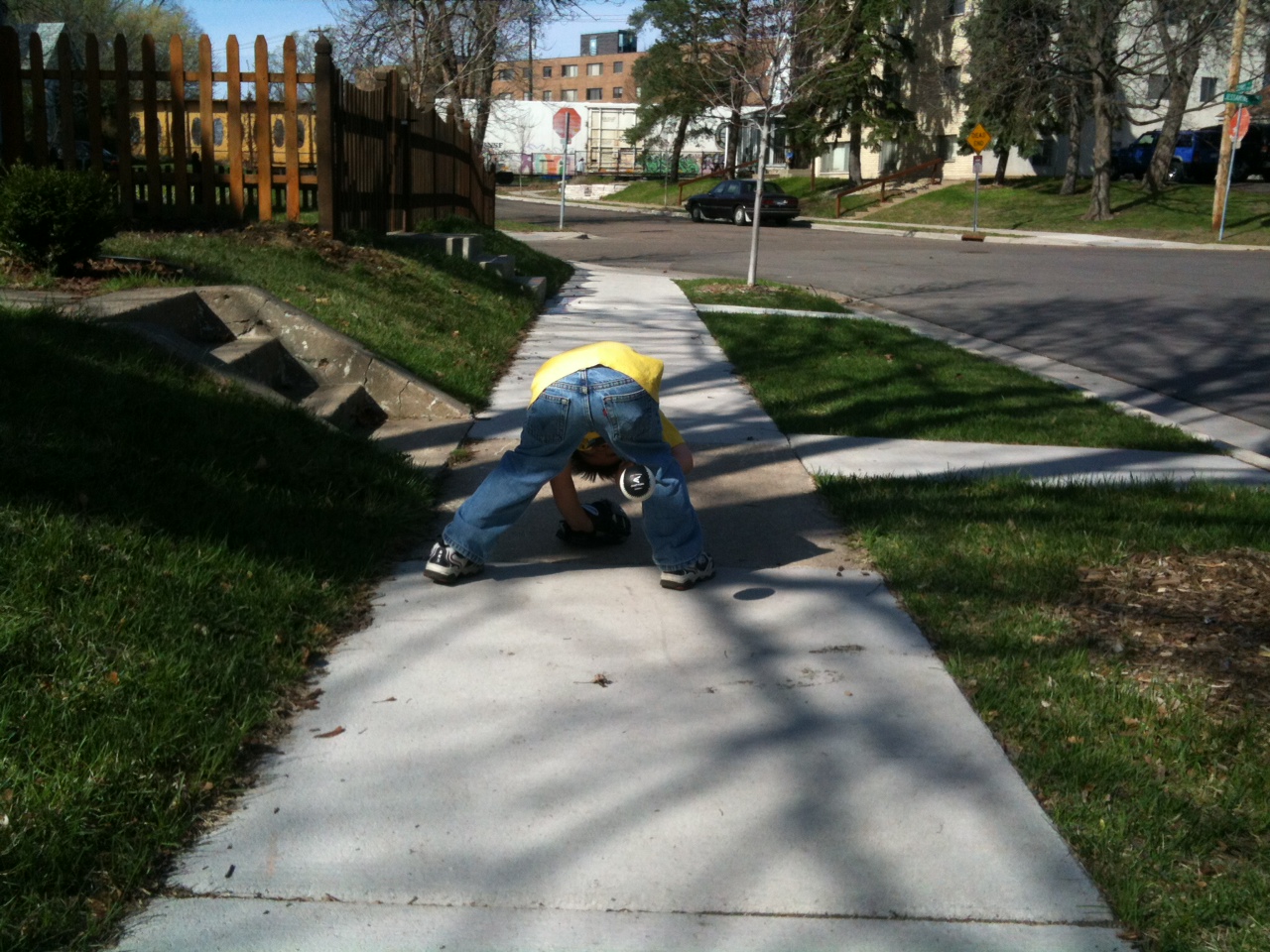
The super upside-down through the legs throw!

The Clash of Humanity!

Had a stressful little turn in Target – the kids with their ever-present sense of entitlement and incredible lack of thankfulness being the stress-makers – that led us after to the Roseville Library to drop off “The Blind Assassin” – brilliant; and “Toward the End of Time” – mostly great but a bit much about the old guy’s lower extremities. I pulled into the parking lot and dropped into one of about 11 unused handicap parking spots in front of the door (totally not my m.o., by the way – i’m usually the guy who gives others the dirty look when they do that), left my car door open in a sort-of “hey, don’t worry, i’m just dropping these here books off and will be out of the way before the 11th handicapped driver pulls up for sure”, but ran headlong into a puffed up gentleman who shouted at me. “Those spots are not for dropping off books!” He was absolutely right, of course, as it’s illegal to park there. I noticed then also that there was no book drop off there anymore.

The Roseville Library – which was recently rebuilt and features a mostly featureless interior and like so many other libraries now seems to want you to know it as a big space with computers with the actual books relegated to elsewhere – moved my book drop. I jumped back in my car, stung and a bit embarrassed as I’m not the guy who takes spots from handicapped people (have I made that perfectly clear?), whipped a u-turn and parked, actually closer to the building, in a drop off zone. The puffed up guy was pulling out of his spot, considerably less puffed up, and our eyes met again. He rolled down his window. I walked over and he actually apologized, “I’m sorry,” he said. “It’s just that my own mother…” I stopped him. “Man, you are absolutely right. Don’t you worry about it.” “There’s a drive up drop-off right over there,” he said, helpfully. “There is?” I asked. The Roseville Library folks decided to move that from the convenient and obvious front to tucked way in the back. “Yeah, right over there.” He pointed.  “Thanks!” I said. And we parted.

Despite the discomfort, I loved the exchange. Now, for some reason, he was embarrassed. And yet I was embarrassed before. It ended so well. I practically had a new buddy -the same guy who looked like he might drop dead of an anger-induced aneurysm just moments before I was now patting on the shoulder through his car window.

After I used the book drop-off, I went back past where he was parked and noticed that he was in one of the spots “saved for vans and car pools only” right next to those spots for handicapped drivers. But I was cool with that – he had a couple of kids with him – and that constitutes a car pool (among other things) by my measure.

My Addiction to Fiction

I’ve always been somewhat embarrassed to say that I really don’t watch much television at all; not because it matters, really, other than the fact that both my brother and sister-in-law are executive producers in that industry. I guess I’ve just never wanted to come off like some holier-than-thou pinhead, but I really do prefer reading. Pinhead Alert!

It’s a weird sort-of guilt, but can certainly be chalked up to my regular Midwestern guy upbringing that basically states, “You’re not fancy. Don’t be a sissy. Shut up about yourself and fit in, lest your head be chopped off.”  Or something like that.

But a new article in the New York Times entitled “Your Brain on Fiction” might just be the proof I needed to prove I’m not holier-than-thou or thee or anyone else. It states basically that recent neuroscience shows that reading fiction engages the brain much more actively than watching television. I’ve always known that but haven’t been able to explain it beyond that which I’ve said a million times: “Any time we are subject to both sound and vision at the same time through the same medium, the brain has nothing to do but sit passively and take it in.”

Reading, on the other hand, forces you to fill in the blanks – to take the descriptions and build the image in your head; it’s much more active, and therefore, engaging and interesting, at least to the likes of me. The article shows that the areas of the brain the, say, recognize movement, smell or texture fire up when reading words that effectively communicate actions, scents or tactile feelings. And, more interestingly, that does not happen with television.

So I am no sissy. I just need more stimulation. Nothing wrong with that, at least with entertainment. It makes me wonder, though, if avid readers of fiction are more apt to be addicts. I’ll leave it up to the neuroscientists to figure that out.

Why I Love Minnesota #72

The top-performing stock of the past 25 years isn’t Apple or Microsoft. It’s Minnesota-based hardware supplier Fastenal, which is up 38,565 percent since the market crash of 1987. Told of the distinction, 72-year-old founder Bob Kierlin said, “Oh, wow. Gee. Well, thanks. That’s great news.”


what do you hear?

“The faculty of embarrassment was located in the pregenual anterior cingulate cortex by neurologists who made brain-damaged subjects sing along to “My Girl” and then listen to their own singing played back without musical accompaniment.”

From Harper’s Findings June 2011

Forget “brain-damaged”, most people are at first uncomfortable with their own voice when they hear it played back on another device – even embarrassed. Somehow the resonance of our voice in our heads often sounds quite different from how we sound to the rest of the world, and that sudden realization can be startling. Why is that? Is it just the surprise that we sound different? Personally, I was shocked at just how nasally I sounded playing back my voice on our little cassette recorder as a kid. I remember asking, “Is that how I sound?” And my sister giving me the bad news.

Makes me wonder, too, whether people hear other people’s voices differently from one another, possibly related to the size, shape and location of the ear and ear drum. Could it be that my daughter’s enjoyment of the singing of her pubescent Disney stars is related to just how differently her ear is to mine? Why is it that bagpipes make me want to tear my ears off while others find them beautiful?

I’ve often wondered if other people see colors differently as well. Is my blue your green? Why should they be the same exactly? To me it actually makes more sense that we all see them somewhat differently, if not completely. My brown is your gray. Without any prodding as far as I can tell, my daughter fell in love with pink as a color – as so many young girls do, but I’m certain (no, hopeful) that “my girl” will soon learn to love other colors as vividly. Something oddly creepy about an older woman purposely surrounding herself in too much pink.

To each his or her own, I suppose, and for good reason maybe.

The Grover BORGquist

The Grover BORGquist: resistance, apparently, is futile

The Grover BORGquist descended upon the Publicant’s and entered the party through the bottom, taking the easy path past the least of them; then veered right again and captured most of the rest of them. They signed themselves over, pledging themselves to assimilation with the BORGquist, They gave in and gave up on independent thought and action. (‘Rolled over and took it up the sick bay,’ might say.)

Cantinacrats

Meanwhile at the Democantina, all hell was breaking loose again. The party was on, everyone was represented – locals, freaks, foreigners – and everybody was demanding to be heard, like barkers at some whacked out baazar and there was no order because there were too many people and too many opinions; factions; ‘factionistas’ one man opined. Cantinacrats. But the music was good.

Equalized to Insanity

My daughter is now six and so liking her music and the music she likes is what you hear on KDWB. I know this because she asked me to tune to KDWB in our van on the way home from the cabin, which I did.

Now if you were ever at the Saloon or Gay 90s in the 80s you would believe as I do that much of this KDWB music has got to have been produced by the same dudes who were making all that 180+ BPM super-charged gay disco back then. But they spike the treble weirdly now, apparently to accentuate the teeth-grating auto-tune. After a while I just kind of wanted to punch someone.

But my daughter thinks it’s all cool so I’m prepping myself for music negotiations that will undoubtedly take place in the years to come. How often will Led Zeppelin win out over Lady GaGa?

It is my van.

learn after you leap

“Scientists concluded that … frogs learned to leap before they learned how to land,” which is obvious at one level, I suppose, but also inspiring at another. Not only for many of us who experience a certain amount of trepidation when up against that moment that separates the leapers from the losers, but for frogs, as well, who’ve been relegated to croaking, slow-moving blobs by much of popular culture.

It’s hard to learn how to land without leaping first, but having the fortitude to leap first is where the excitement begins. Suddenly, I wish I were more like a frog.

nothing is impossible

I’ve got this picture of my cousin Perry Barnes water skiing except he’s on a disk and not skis and on the disk – maybe three feet in diameter – he’s placed a stool – maybe two feet tall – and it’s 1971 and he’s got a kickass mustache and he’s standing on the stool skimming along at 25 miles an hour on a sunny summer day on South Long Lake. Brilliant.

Nothing is impossible.