
Some contrived bit of theater? “I’m this!” When you’re that? Dichotomies and schizophrenias. Jim said, “I’m doing well!” Julie didn’t believe him. Or did she? She loved life. Nate was great. “‘How much money did they have?’ “It’s not about money!” She thought.“It’s about love.” Nate hated that…everything. “Fuckin’ stupid fuckin’ people!” was an oft-heard refrain. But inside, let’s say it together, are you ready?… he cried. But he really did. So angry he cried. Or so sad he got mad. But which was right/Nate?
Who are you
right
now?
Category: As it should be
people crave ritual
people crave ritual
and not much more than that
trusted moments
where nothing
bad
can happen
and there’s
joy
in repetition.
jesus and steve

Electric Strings
A balloon is mostly empty space
but then again so am I
gravitating toward the ground
yet she can float up to the sky.
I guess it’s her propensity,
and relative density
that leaves me here on terra firma.
But terra, too, is hardly firma.
The space between the particles
is vast as planets ’round the sun,
the distance of their orbitals;
and it’s not hard, it’s hardly there
just tiny specks, to say, is fair:
like grains of sand spread far apart
that hold up ox and man and cart.
Now let’s dig deeper, to the protons,
electrons, quarks and, now it’s, jeepers!
Electric strings that make us all,
harmonized, lest we fall
through the earth, like unballoons
thank God he plays the proper tunes.
Some dissonance, oh, lord, that harp!
We’re gonna die, He’s playing sharp!”
Imagine that. Imagine God.
We’re good at that. We wink and nod.
But others like to look much deeper
find their truths, each one a keeper.
String them together to fashion a rug
that holds us up so we can shrug,
ignore the beauty beneath our feet
and gasp at heaven’s phantasmal feat.
Just a Couple of Guys Who got Me Thinking
I read the obituaries in the Star Tribune every Sunday. I like to learn about the people who died. Mostly there is nothing to learn other than age, where they’re from, who died before them and who survives them. But sometimes they are much more interesting – often poignant, every so often even funny. As you can imagine, I like those best because I can get a much better sense of the person and of those who loved them. There was one in particular this Sunday – a young man named Tyler P. Thoresen.
Yesterday’s paper also contained an article about a man named Jim Moore. Jim had a rather quirky sense of humor and one day when he was younger and lamenting the fact that no one wrote letters any more, he went to a map, picked Turtle Lake, MN, then picked a typical Minnesota name – Olson, found an Olson family in Turtle Lake, and then a few times each year he would send them postcards. “Hoping to go sailing tomorrow if the old leg isn’t bothering me too much. Jim” or “Was in Paris and saw Francois and Emilie. They send their regards. Jim”
I found that just spectacular – beautiful, random and kind of touching. The Olson family loved the notes. They had no idea who Jim was, but they still got a real kick out of getting the cards. They kept every one of them. Jim developed bile duct cancer and died in January. Jim’s friend sent the Olsons a note telling them about Jim, why he had written and that he had passed away. Jim was just 38.
Tyler Thoresen was just a month shy of his 28th birthday when he died. Tyler suffered from schizoaffective disorder and like Jim, the illness eventually killed him. Tyler’s obituary paints a picture of a great guy – funny, athletic and a lover of good food. What really got me was how his family chose to begin his obituary: “Tyler Thoreson, of New Brighton, chose to end his earthly struggles on March 20th, 2012…”
Mental illnesses are often sorely misunderstood and that ignorance leads to stigma – and that stigma, if you’ll excuse my terminology, is bullshit. People like Tyler, his family and loved ones face that stigma every day, despite all the amazing work that organizations such as NAMI Minnesota – to which they have directed memorials – accomplish. That stigma is tenacious. And that’s why I so appreciated their obituary.
Tyler’s family could have used some euphemism to describe how Tyler died, but instead they just said it and said it beautifully: “…chose to end his earthly struggles…” They went on, “While he was burdened with schizoaffective disorder for most of his adult life, that is not what defined him.” Indeed. And struggles they no doubt were as he took his own life.
Mental illnesses are just that – illnesses – and not only do the sufferers and their families have to deal with the illness, but with the stigma as well. This obituary is just one more step in the right direction. Take that, stigma. Screw you, ignorance.
I didn’t know either of these guys so it’s a bit presumptuous of me to be sitting here writing about them. But they both touched me. I guess that’s how we live on after death. The rest of us learn from those who left before us – in how they lived and how they died. Life is precious – and precipitous – so let’s keep an eye out for one another, reach out to strangers, and work hard to understand them and their suffering. Thanks for the lessons, guys. Godspeed and all that.
Full disclosure: My company has had the pleasure of working with NAMI Minnesota over the last eight or so years developing their educational materials, and it’s no doubt the most important work we do.
Boggling Minds
Think about your mind. Think about the fact that you can think. Think about the fact you can think about thinking. Meta that. Imagine a green airplane with wings with rainbow feathers and a nose the shape of soft serve ice cream cone – chocolate brown, with a purple octagon shimmering at the tip. Think about your imagination.
You can read tiny characters in sequences and glean complex ideas and images from those tiny characters. You can look at a page of notes and translate that through your fingers into beautiful music. You can invent stories. You can imagine the future and remember the past. You can come up with brilliant, dangerous and hare-brained ideas. You can paint pictures and make movies. You can multiply and divide; add and subtract and maybe even do calculations that to many others would be beyond abstract. You can see, hear, feel, taste, smell.
The scent of baking can reach deep into your mind and pull memories of your grandmother forth for your review. A movement of a symphony can move you to joyful tears. Too much heat and your brain will yank your hand away, long before you conscious mind knows to. You can taste the difference between Chablis and chardonnay.
You can love a person with all of your heart. You can feel another human’s suffering. You can stand up for what you believe in. You can sit down and watch the sun set.
Your brain is unbelievably, unequivocally, undeniably amazing. Think about just how spectacular your consciousness is – your awareness! The breadth and depth and sheer enormity of it!
Now think about the fact that there are 7,000,000,000 (seven billion!) other equally spectacular minds humming along right now on this tiny planet.
Think about the power of that.
Catch
What is it about playing catch? How can such a simple past-time be so dog-gone satisfying?
Playing catch has but two actions – throw and catch. It has but one rule that need not ever be spoken or written down (but here I go anyway): throw the ball so the other person has a chance to catch it. That’s really about it. So as competition, it’s mostly personal. It’s you against you, but you get to play with someone else, so it’s also social – an opportunity for camaraderie.
Catch moves at whatever pace you want. It’s as challenging as you decide. It can be as fast, physical, cerebral or meditative as you make it. It’s perfect, catch is. Throw. Catch. Throw. Catch. Throoowww. Catch. Throw. Catch. That’s it, in a nutshell.
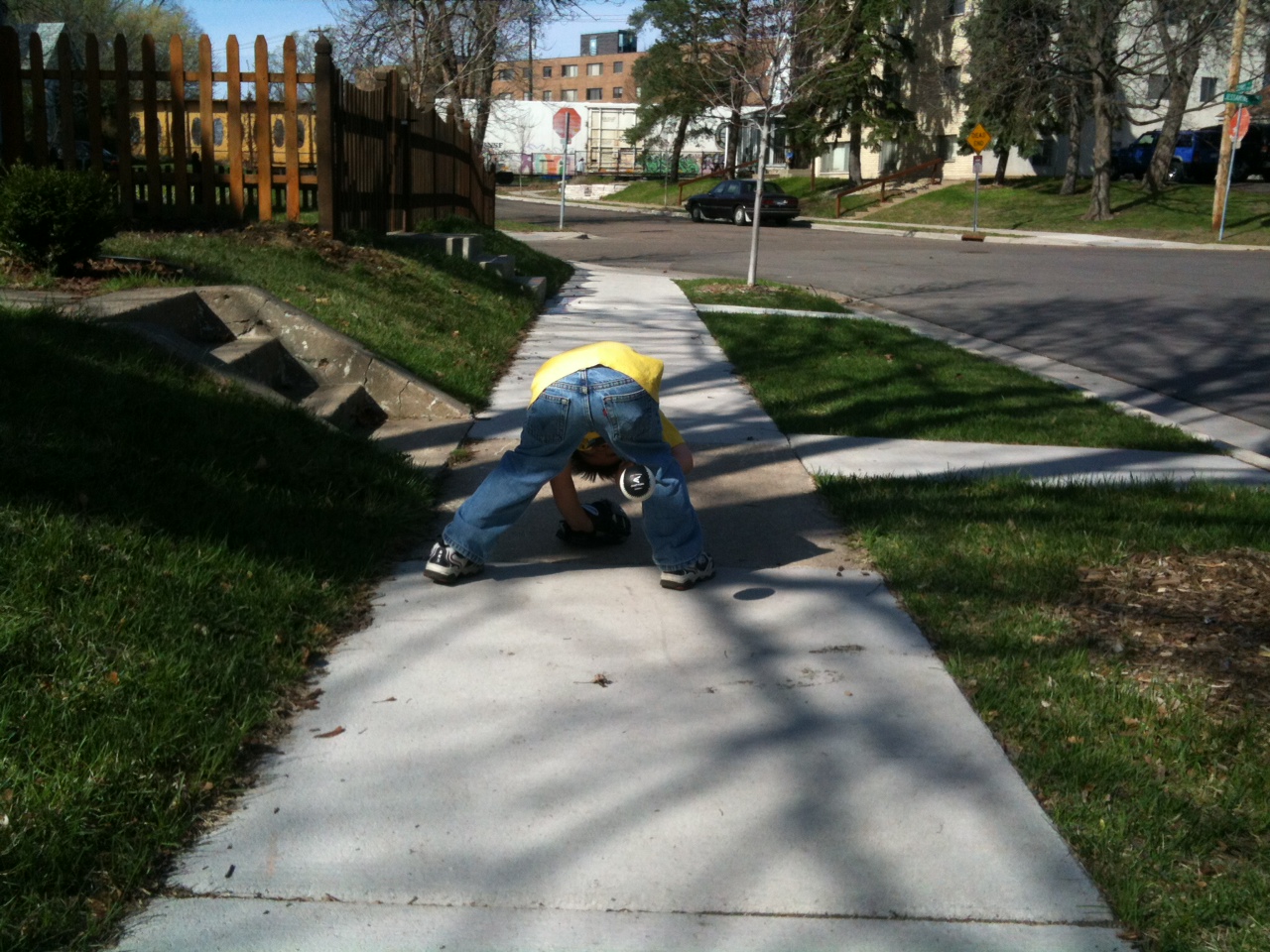
I spent a good part of the weekend playing catch again for the first time in years. My boy is four and yesterday we purchased balls and mitts and already he’s smitten. I heard it all weekend: “Let’s play catch, Dad!” And me, with Cat Steven’s “Cat’s in the Cradle” reverberating in my head, said, “You got it, buddy!” And out we went.
The tenor of our catch is set by his being four. I lob the ball up into an arc that is intended to land squarely in his mitt. He catches it or doesn’t, then throws it as best he can, and I catch it, or more often, turn and run after it.
But we’re in heaven and the banter is entirely spontaneous yet practically written in stone: “Nice catch!” “Oh! In and out of the glove!” “Rule number one: Use two hands!” “I catched it!” “Gotta lean in for those!” “Squeeze the mitt!” “I’m gonna throw it way high!” “Nice!” “My bad!” “What was that?” “Whoa! Great throw, buddy!” And on and on.
Oh, and “It’s ‘caught’, buddy, not ‘catched’.” A little grammar thrown in for good measure.
In fact, catch is a teaching opportunity that never ends, and because of its very simplicity, you will never fully learn it. You can always improve and every catch is different. You can drop one, but catch allows you to learn and move on to the next catch.
And with a kid, the teaching is simply part of the action. There we are just throwing and catching a ball. It’s not like I’m sitting there explicating the importance of bike safety or saving money. And yet within the lessons of catch are hidden other life lessons about fairness, respect, effort, pride and so on. You’re talking catch. You’re learning life. “Way to go, buddy!” Brilliant.
 Luke Soiseth